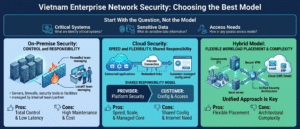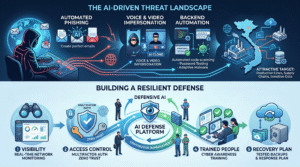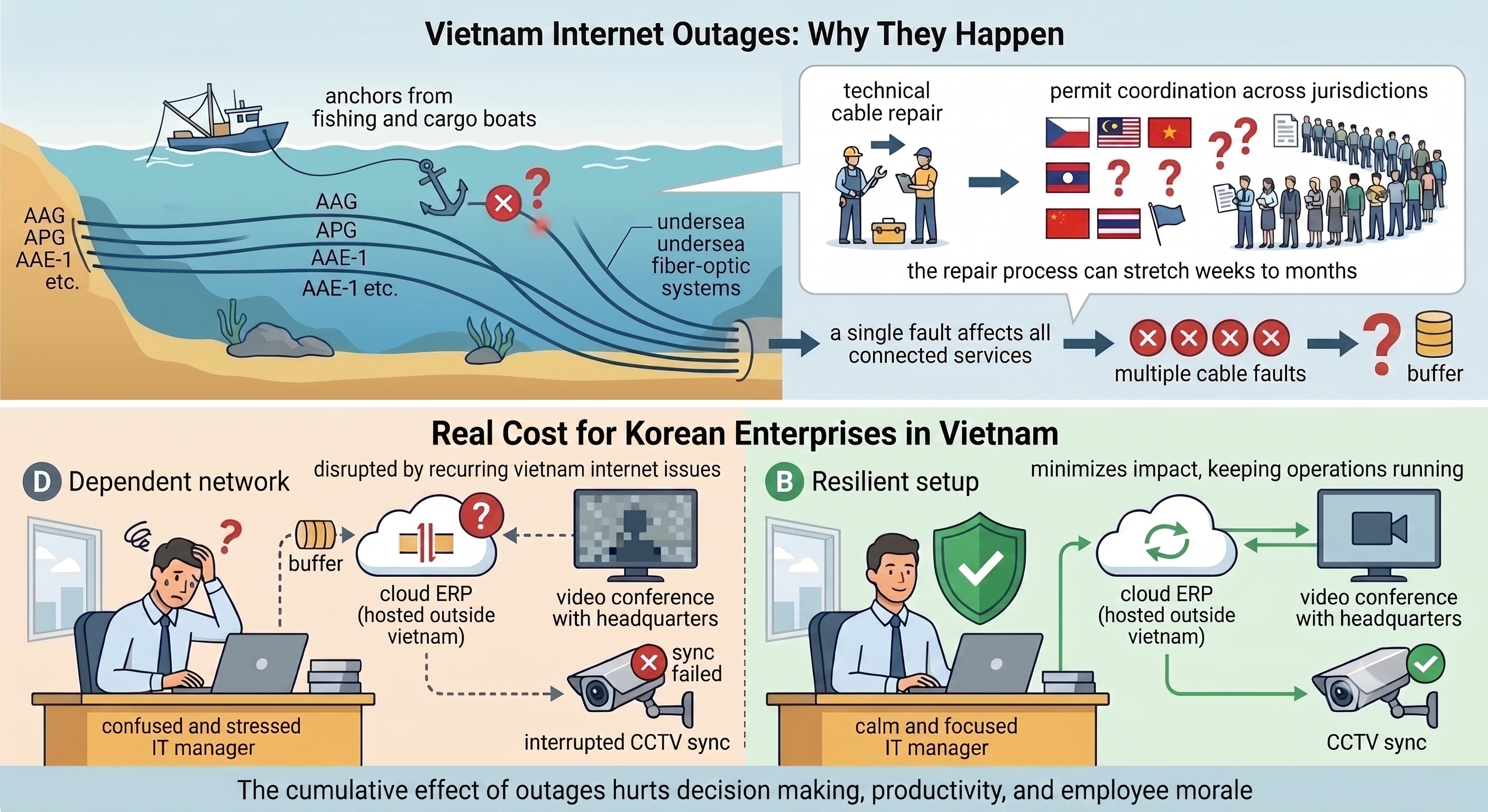
In almost every planning discussion with IT managers at international and Korean enterprises in Vietnam, one question comes up sooner or later. A company opens a new factory or office, adopts a few cloud services, keeps some systems in its own server room, and then someone asks where the security strategy should actually begin. Should it follow the data into the cloud, stay anchored in the company’s own infrastructure, or take a combination of both?
There is no single answer that fits every business, and anyone who claims otherwise deserves some caution. This post explains how each model approaches network security, what it means for companies operating between Vietnam and a headquarters abroad, and how to choose a starting point that matches the actual situation of the business.
Start With the Question, Not the Model
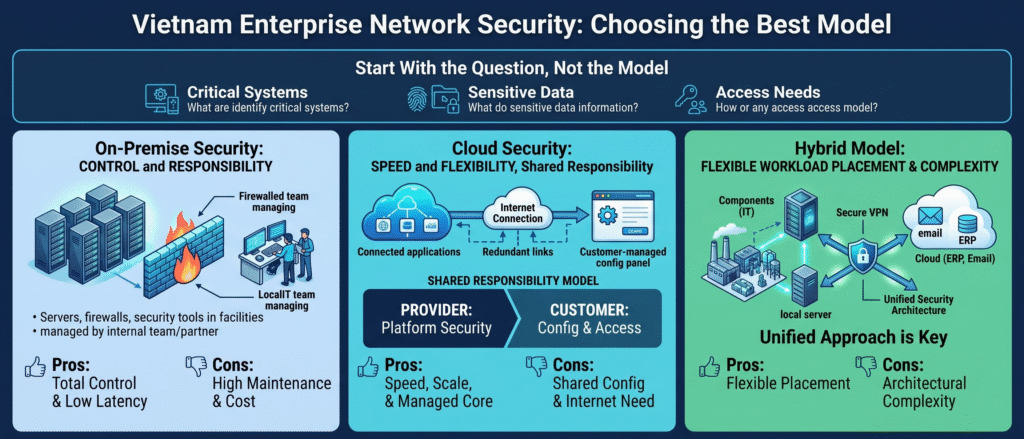
Many companies approach this topic as a technology decision, comparing cloud, on premise, and hybrid as if they were products on a shelf. Which systems keep production running? Where does sensitive data such as product designs, customer records, and financial information actually live? Who needs access to it, from which locations, and on what devices? How much downtime can the business tolerate before customers and headquarters begin to feel the impact?
Once these questions are answered, the choice between deployment models usually becomes much clearer. Security architecture should follow business requirements, rather than the other way around.
On Premise Security: Control and Responsibility Together
An on-premise approach means that servers, firewalls, and security tools are located in the company’s own facilities and managed by its own team or a trusted partner. The main advantage is control. The company decides where data is stored, how the network is segmented, and which policies apply, and core operations do not depend on the availability of an external platform.
This model remains very relevant for manufacturing environments in Vietnam. Production systems, machine controllers, and factory networks often require very low latency and must continue to operate even when the internet connection is interrupted. Some companies also have contractual or internal rules that require certain data to remain within a specific location, which makes an on premise design the natural choice for those workloads.
The cost of that control is responsibility. When everything is hosted internally, the company is also accountable for patching, hardware renewal, capacity planning, monitoring, and coverage at all hours of the day. Equipment ages, skilled security staff are difficult to hire and retain, and a small IT team can find it hard to keep up with the pace at which threats evolve. An on premise environment that is not actively maintained can become less secure than a well managed cloud service, which is a point that is often overlooked.
Cloud Security: Speed and Scale With Shared Responsibility
A cloud approach moves applications, data, and often the security controls themselves to a provider’s platform. The strengths are speed and flexibility. A new office or a new application can be connected quickly, capacity can grow with the business, and major cloud providers invest heavily in the underlying infrastructure, including physical security, resilience, and many protection features that come included. Cloud based security services, such as secure web gateways, cloud firewalls, and identity protection, also make it easier to apply consistent policies to remote and traveling employees.
However, cloud security is built on a model of shared responsibility, and this is where many organizations run into trouble. The provider protects the platform, but the customer remains responsible for how it is configured, who is given access, and how data is classified and protected. In practice, many cloud incidents originate from simple misconfigurations such as storage that is unintentionally exposed, excessive permissions, or accounts without strong authentication, and not from a failure of the provider itself.
Cloud adoption also makes the quality of the internet connection part of the security and productivity posture of a company. If an office reaches its critical applications through a congested or unstable link, employees may be tempted to bypass controls simply to get their work done. A reliable and well designed connection to the cloud, with redundancy where the business requires it, is therefore a foundation rather than an optional extra.
Finally, companies should consider data residency and regulatory expectations. Vietnam has been developing its requirements on data protection and cybersecurity, and Korean parent companies often apply their own policies to overseas subsidiaries. Before moving sensitive workloads, it is worth confirming where the data will be stored, who can access it, and whether the arrangement fits both local rules and group standards.
Hybrid: Why Most Enterprises End Up Here
In reality, very few established companies are purely cloud or purely on premise. A typical Korean manufacturer in Vietnam may run production systems locally, use a cloud platform for collaboration and email, connect to a global ERP hosted elsewhere, and allow staff to work remotely. This is a hybrid environment, whether or not anyone planned it that way.
The benefit of a hybrid model is that each workload can be placed where it fits best. Systems that are sensitive to latency or heavily regulated can stay close to the factory, while flexible and collaborative services can live in the cloud. The challenge is that security becomes more complex, because policies must be consistent across very different environments, traffic moves between locations with different levels of visibility, and gaps can appear at the points where the two worlds connect.
A hybrid design therefore works well only when it is treated as one coherent architecture. That means a unified approach to identity and access, so that the same user is verified in the same way whether they reach a local server or a cloud application. It means secure and well monitored connections between sites and cloud platforms, together with a clear view of traffic across all of them. It also means that logging and monitoring are brought together, because an attacker who moves from a cloud account into the internal network will not be noticed if each environment is watched separately.
So Where Should Security Start?
Security should begin with the elements that remain constant regardless of where workloads are hosted, and these can be described as four foundations.
The first is visibility. Nothing can be protected if it cannot be seen, so a complete inventory of sites, devices, applications, and cloud services is the starting point for every model. Many organizations are surprised to find systems and accounts that nobody was actively managing.
The second is identity and access. In a world where users and applications are spread across offices, factories, and cloud platforms, the question of who is allowed to reach what becomes more important than the location of the server. Strong authentication, careful control of administrator rights, and a zero trust mindset that verifies every request apply equally well in all three models.
The third is the network itself. Segmentation between office, production, and cloud connected zones limits how far an intruder can move, and modern firewalls that inspect encrypted traffic, secure remote access, and dependable internet connectivity form the backbone on which any deployment model depends. Since the network is the common thread between on premise systems and cloud services, it is the natural place to anchor a security strategy.
The fourth is detection, response, and recovery. Whether through an internal team or a managed security service, companies need monitoring that covers all environments and a tested plan for what happens when something goes wrong, including backups that are stored separately from the main network.
Once these foundations are in place, deciding which workloads belong in the cloud, which should remain on premise, and how they should be connected becomes a much more manageable exercise.
A Practical Way to Move Forward
Large and disruptive projects are best avoided at the beginning. A more effective path is to review the current environment, identify the most critical systems and the most exposed connections, and then improve the architecture in stages. For example, a company may first strengthen identity protection and monitoring across everything it already runs, then redesign network segmentation, and later migrate selected workloads to the cloud with security policies already defined.
It is also valuable to involve a partner who understands both the technical and the business context. BeyondNet supports international and Korean enterprises in Vietnam with internet connectivity, network infrastructure, and managed services, and the team is familiar with the realities of coordinating with a headquarters abroad while meeting local requirements. Communication is available in English or Korean, which helps ensure that technical recommendations are understood by everyone who has to approve and use them.
Cloud, on premise, and hybrid are not competing answers to the same question. Each is a tool that suits particular workloads, and most companies will use more than one of them over time. The organizations that manage this well do not begin by choosing a model, but by understanding their data, their users, and their network, and by building security controls that follow the business wherever it operates.
For companies that would like to review how their current environment is structured and where their security priorities should lie, the BeyondNet team would be glad to help with a network assessment and a practical roadmap.