Why Vietnam Internet Outages Happen So Frequently
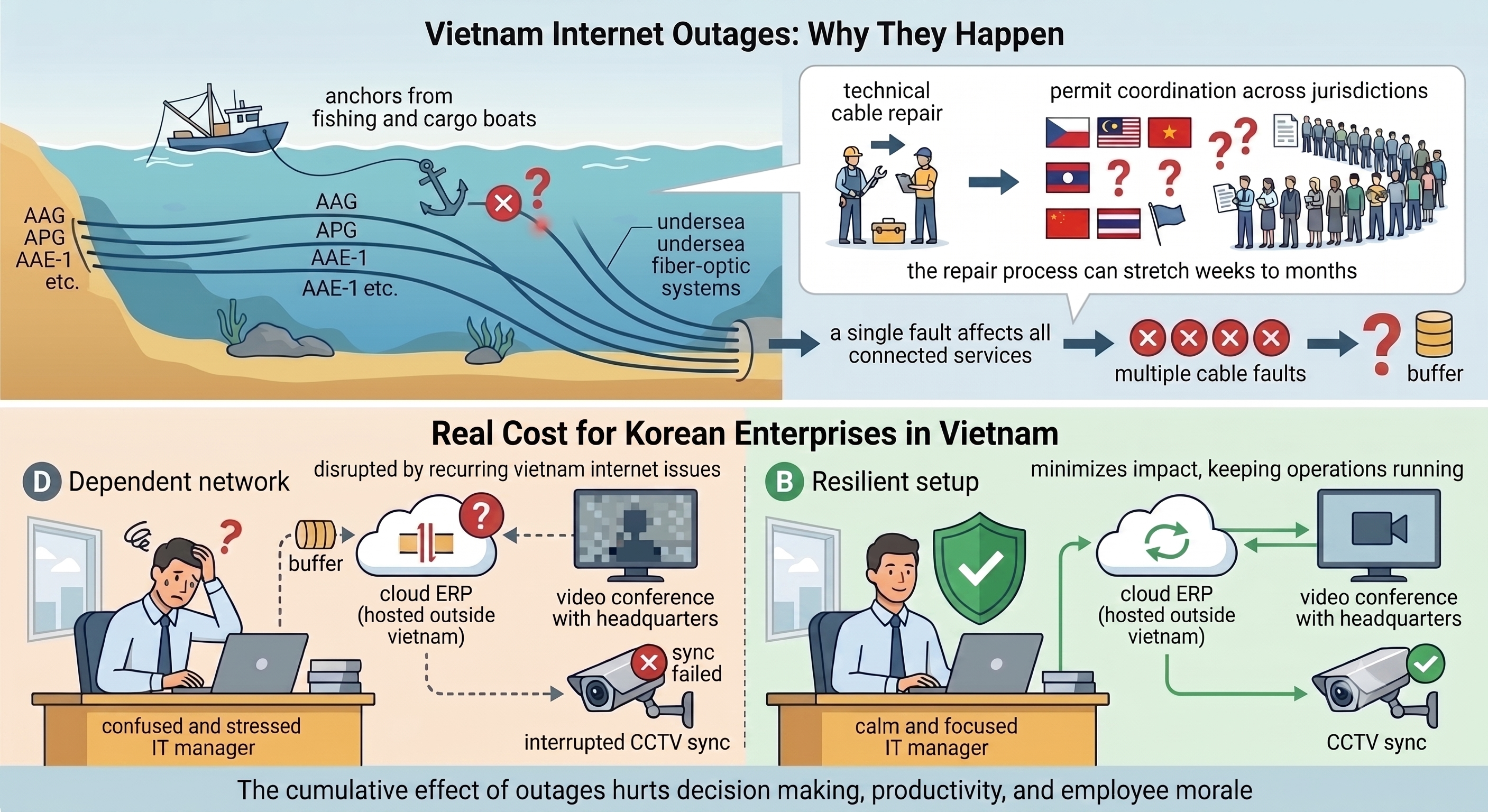
Vietnam connects to the rest of the world primarily through a handful of undersea fiber optic cable systems, including AAG, APG, AAE-1, IA, and newer additions such as ADC and SJC2. These cables run along seabeds that see heavy shipping traffic, and a large share of damage traces back to something as mundane as a fishing boat or cargo vessel dragging its anchor across a cable line. Natural wear, aging infrastructure, and occasional seismic activity also play a role.
What makes the situation particularly challenging is not the frequency of damage itself, since undersea cables around the world experience faults regularly, but rather how long repairs tend to take once a fault occurs. Fixing a cable requires a specialized repair ship to locate the exact point of damage, obtain permits from multiple governments whose waters the cable passes through, and complete the physical repair at sea. Industry representatives in Vietnam have noted that this process can stretch from several weeks to as long as half a year, and in some cases even longer, largely because coordinating permits across different jurisdictions is far more complicated than the technical repair work itself.
Because Vietnam has historically relied on a small number of cable systems for the bulk of its international bandwidth, even a single cable fault can noticeably affect Vietnam internet speed, particularly for services that route heavily through the affected path. When two or more cables fail around the same time, which has happened more than once in recent years, the impact becomes harder for local providers to absorb quietly.
The Real Cost for Korean Enterprises Operating in Vietnam
For a business that serves only domestic customers, a temporary dip in international bandwidth might be a minor inconvenience. For Korean enterprises whose operations are deeply integrated with headquarters in Korea, the calculation looks very different.
Consider a manufacturing company that relies on a cloud-based ERP system hosted on servers outside Vietnam. When a Vietnam internet outage slows international routing, production planning, inventory updates, and financial reporting can all fall behind schedule at exactly the moment when accurate real time data matters most. Video conferences with headquarters, which have become the default way many Korean companies coordinate strategy and resolve urgent issues, become unreliable exactly when clear communication is needed. Even something as routine as syncing CCTV footage from a factory floor to a central monitoring system can be interrupted, leaving gaps in security coverage precisely during periods when network visibility should be strongest.
These disruptions rarely make headlines, and their cost is often invisible on any single day. Yet when they recur several times a year, the cumulative effect on productivity, decision making speed, and even employee frustration becomes significant enough that many operations managers eventually start asking whether their current network setup is truly built to handle Vietnam internet problems as an ongoing reality rather than a rare exception.
Vietnam’s Infrastructure Is Improving, But That Does Not Solve Everything
To be fair, the overall picture has been improving. Vietnam has been actively diversifying its international connectivity rather than depending solely on undersea cables. A new domestic fiber route connecting Vietnam directly to neighboring countries by land has recently come online, giving local operators a path that does not depend on cable repair ships or maritime permits at all. Satellite based internet service has also begun trial operations in the country, offering another layer of backup for extreme cases where ground infrastructure is affected.
These developments mean that a single cable fault today is less likely to cause the severe nationwide slowdowns that occurred in past years, since providers can now redirect traffic across multiple paths more effectively than before. This is genuinely good news for the overall resilience of Vietnam internet infrastructure.
However, national level resilience and individual company level resilience are not the same thing. Even when total national bandwidth losses stay under ten percent during a cable fault, the actual experience for a specific business depends entirely on which provider it uses, how that provider routes its traffic, and whether the company has any backup connection of its own. A business relying on a single internet service provider through a single physical line remains just as exposed to localized slowdowns as it always was, regardless of how much redundancy exists at the national level. The country’s infrastructure being more resilient does not automatically mean every company’s connection is more resilient.
Building a Network Strategy That Does Not Depend on Luck
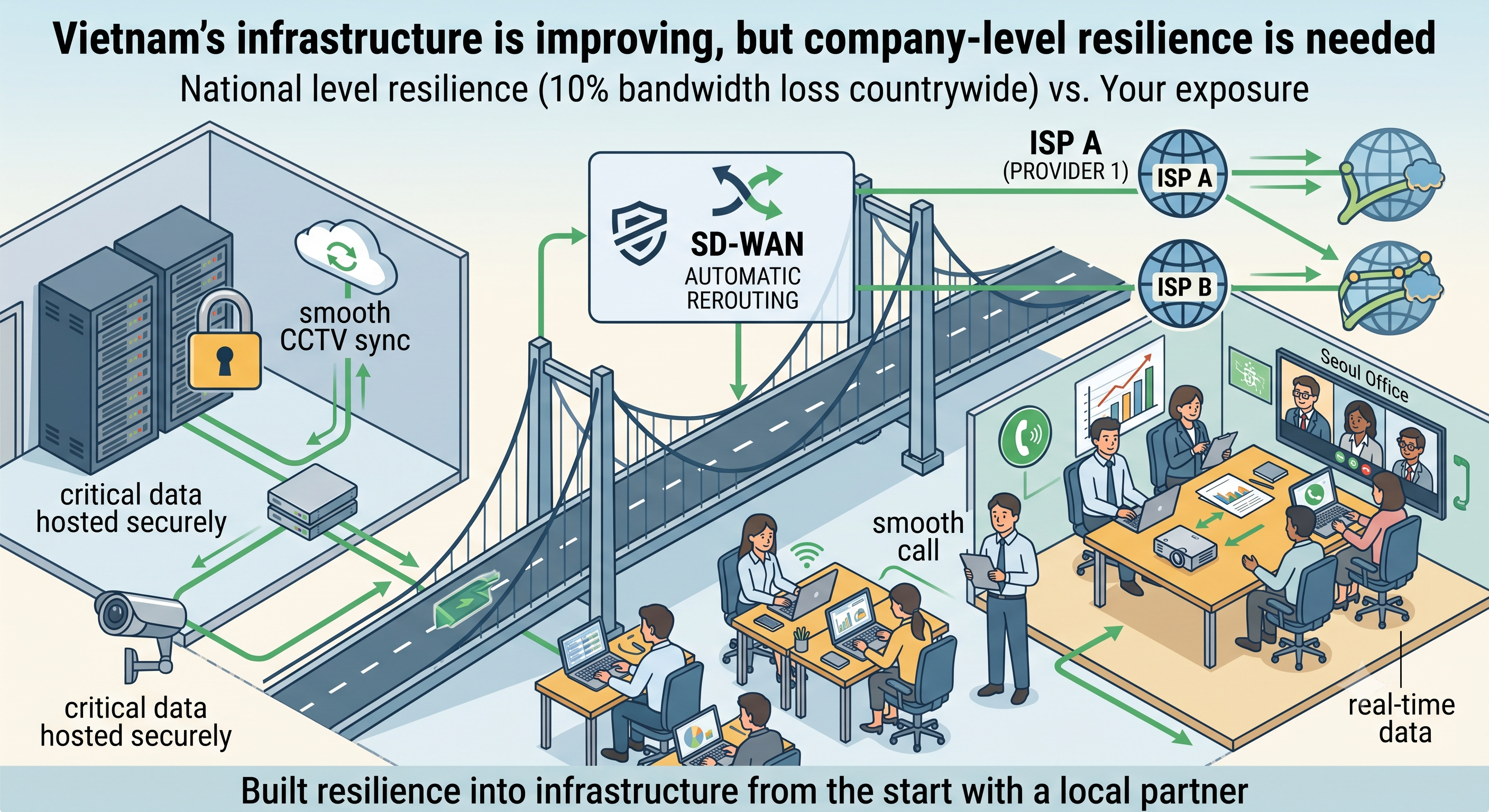
This is where the conversation shifts from understanding the problem to actually solving it at the company level. Rather than waiting anxiously for the next cable fault announcement and hoping the impact stays minimal, forward thinking Korean enterprises are increasingly building dual redundancy into their network design, meaning they maintain connections through two separate internet providers so that if one path degrades, traffic can shift to the other with minimal disruption.
Technologies such as SD-WAN take this a step further by allowing traffic to be automatically rerouted across multiple available connections in real time, without requiring manual intervention from IT staff during a crisis. This approach represents the current standard for enterprise-grade connectivity, particularly for companies managing operations across multiple sites or coordinating closely with headquarters overseas
The businesses that weather these recurring disruptions most smoothly tend to share one thing in common. They stopped treating network resilience as something to think about only after an outage happens and instead built it into their infrastructure from the start, often working with a local partner who understands both the technical landscape and the specific operational needs of Korean enterprises in Vietnam.
Undersea cable faults are not going away entirely, and given the geography and shipping traffic around Vietnam, they are likely to remain a recurring feature of doing business here for the foreseeable future. The real question for any company is not whether the next disruption will happen, but whether the network behind daily operations is designed to absorb it without anyone in the Seoul office ever noticing.