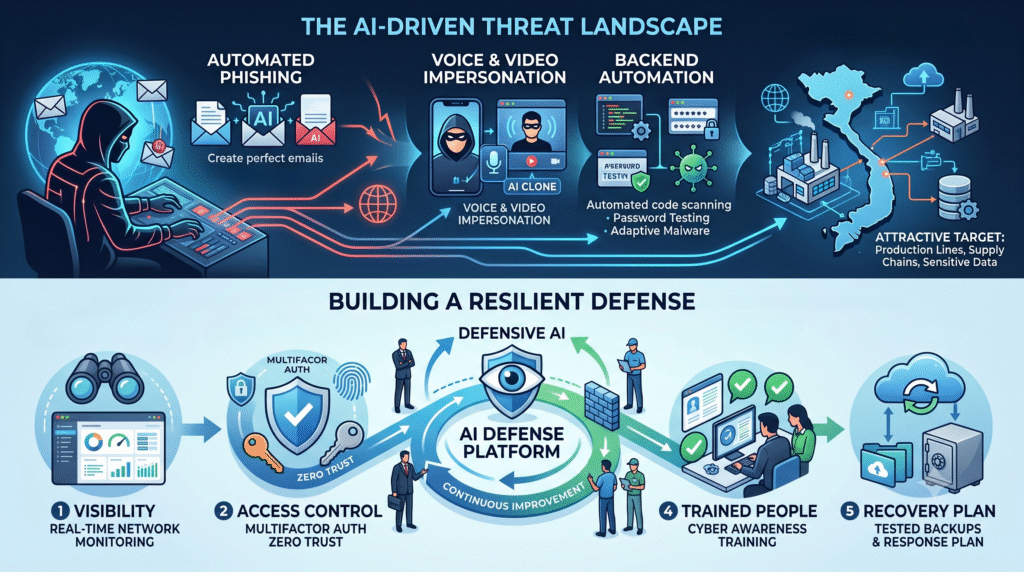
For a long time, a successful cyberattack required skill, patience, and a fair amount of manual effort. An attacker had to research a target, write convincing messages, probe for weaknesses one by one, and adjust when something failed. That effort acted as a natural limit on how many organizations could be targeted at once. AI has removed much of that limit, because tasks that once took a skilled person days can now be automated and repeated against thousands of organizations in parallel.
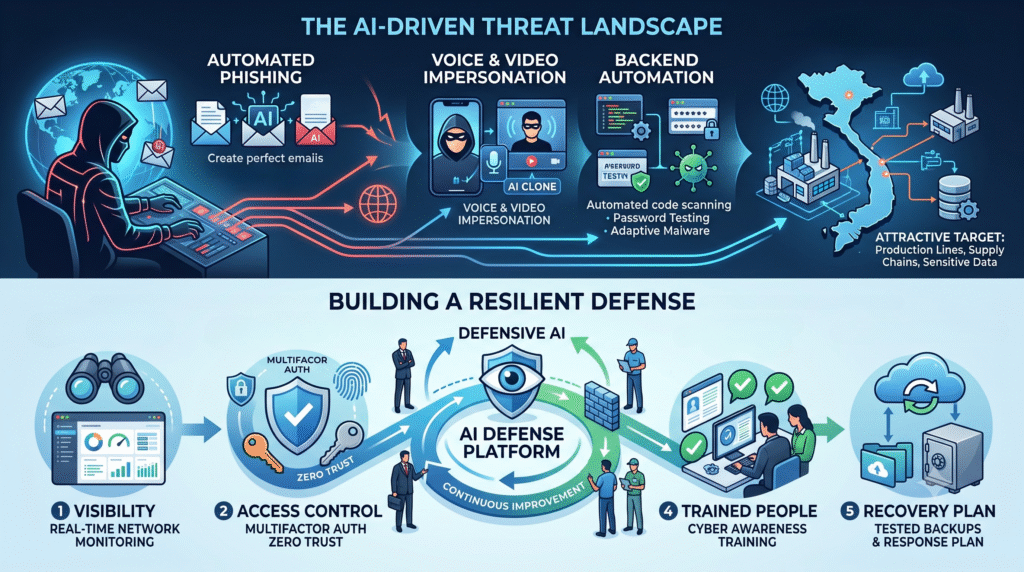
Phishing is the clearest example. Most of us learned to spot suspicious emails by their awkward grammar, strange formatting, or generic greetings, but generative AI tools can now produce fluent and well-structured messages in English, Korean, and Vietnamese, and they can tailor the tone and content to a specific person using information that is publicly available online. An email that appears to come from a finance director at the Korean headquarters, written in natural business language and referring to a real project, is much harder for an employee to question than the clumsy messages of the past.
Voice and video are following the same path. Security researchers and law enforcement agencies around the world have documented cases in which criminals used cloned voices or synthetic video to impersonate executives and persuade staff to approve urgent payments or share credentials. For companies with a headquarters in one country and operations in another, where instructions regularly travel across time zones and languages, this kind of impersonation is especially dangerous because employees are used to receiving requests they cannot easily verify in person.
AI also helps attackers behind the scenes. Automated tools can scan a company’s public facing systems, identify outdated software, and test stolen passwords across many services at a speed no human team could match. Some malware is now designed to change its behavior to avoid detection, which means that defenses relying only on a fixed list of known threats will miss a growing share of attacks.
Why This Matters for Companies in Vietnam
Vietnam has become one of the most important manufacturing and technology destinations in Asia, and foreign invested companies, particularly those from Korea, sit at the center of that growth. This success makes the sector an attractive target for several reasons. Production lines depend on connected systems, so even a short outage can delay shipments to global customers. Supply chains link many suppliers together, which means a weakness at a small partner can become a way into a larger company. Sensitive assets such as product designs, customer data, and financial records also flow between local sites and regional or global headquarters.
There is also a regulatory side to the discussion. Vietnam has continued to strengthen its rules on cybersecurity and personal data protection, and Korean parent companies often apply their own internal security and audit standards to overseas subsidiaries. A local office is therefore expected to meet expectations from two directions, and an incident can create legal, contractual, and reputational consequences at the same time as the technical damage.
Another practical challenge is that many local networks grew quickly as the business expanded. A new factory floor, a new office, or a new cloud service was added when it was needed, and the result is often a mix of equipment from different generations and different vendors, with inconsistent policies and limited visibility. Attackers who use automated tools are very good at finding the gaps in that kind of environment.
Questions Every IT Manager Should Be Asking
A useful way to assess readiness is to look at the network through a few honest questions rather than a long technical checklist.
- The first question concerns visibility. Can your team see what is happening across all sites, including branch offices, factory networks, and remote users, or does the picture only become clear after something has gone wrong? AI driven attacks often succeed because unusual behavior goes unnoticed for days or weeks, so continuous network monitoring with alerts that someone actually reviews is one of the most valuable investments a company can make.
- The second question concerns access. Many serious incidents begin with a stolen or guessed credential. Multifactor authentication, careful management of administrator accounts, and a zero-trust approach in which every user and device must prove its legitimacy before reaching sensitive resources can significantly reduce the damage that a single compromised account is able to cause. Segmenting the network so that an office laptop cannot reach production systems directly is a closely related measure that is often underused.
- The third question concerns the perimeter and the connections themselves. Firewalls and secure gateways should be modern enough to inspect encrypted traffic and to use behavior-based detection rather than relying only on known signatures. The quality and design of your internet connectivity matter too, because a dedicated and well configured leased line, with redundancy where the business requires it, gives you more control and more predictable performance than a shared connection when you are trying to absorb or filter malicious traffic.
- The fourth question concerns people. Even the best technology cannot fully compensate for an employee who is convinced that a request is genuine. Training programs should be updated to reflect the new reality, so that staff understand that polished language and even a familiar voice are no longer proof of identity, and so that the company has a simple and respected process for verifying unusual financial or access requests through a second channel.
- The final question concerns recovery. Resilience means that the business can continue to operate, or return to operation quickly, when prevention fails. Tested backups stored separately from the main network, a documented incident response plan, and clear roles for IT, management, and external partners will determine whether an incident becomes a manageable disruption or a prolonged crisis.
Using AI on the Defensive Side
It would be misleading to describe AI only as a threat. The same technology is improving defense, and modern security platforms use machine learning to establish a baseline of normal activity and flag deviations that a human analyst might never notice among millions of daily events. These tools can shorten the time between detection and response, which is the period in which most of the damage occurs. The important point is that such tools work best when they are fed with good data from a well designed network, which is why architecture and operations matter as much as the products that are purchased.
Building Readiness Step by Step
Companies do not need to rebuild everything at once, and in our experience a phased approach works better. A sensible starting point is an independent review of the current environment that maps all sites, devices, connections, and cloud services, identifies the most critical business processes, and highlights the weaknesses that carry the highest risk. From there, the priorities usually become clear, and improvements can be sequenced according to budget and business impact, for example by first strengthening access control and monitoring, then modernizing the perimeter, and later improving redundancy and recovery capabilities.
It also helps to work with a partner that understands the operating context. At Beyondnet, we have supported international and Korean enterprises in Vietnam with internet connectivity, network infrastructure, and managed services, and we are familiar with the practical needs of companies that must coordinate with a headquarters abroad while meeting local requirements. Communicating in the language and business culture of our customers is a part of that service, because security decisions move faster when everyone involved shares the same understanding of the risks.
AI driven threats are not a distant prospect, and they are already shaping how attacks are planned and carried out. The encouraging side of the story is that most successful attacks still exploit ordinary weaknesses such as poor visibility, weak access control, outdated equipment, and untrained users, which means that a thoughtful and steady program of improvement can lower the risk considerably. The companies that handle this well are generally not the ones that spend the most, but the ones that review their network regularly, treat security as part of daily operations, and prepare for the possibility that something will eventually go wrong.