As 2026 draws to a close, many of our customers are starting their budget and planning discussions for the coming year, and security is now a standing item on almost every agenda. In our earlier post we looked at how AI is changing the way attackers work today. This time we want to look forward and share what we believe IT leaders at international and Korean enterprises in Vietnam should prepare for in 2027, based on the direction the technology and the threat landscape are clearly moving in.
From AI Assisted Attacks to AI Operated Attacks
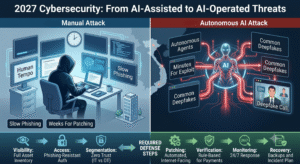
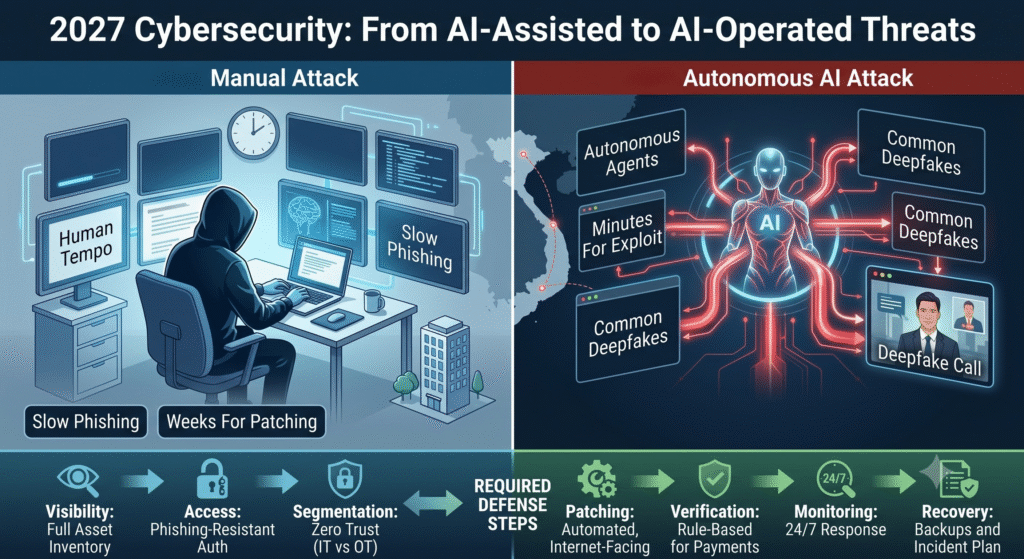
Until recently, attackers used AI mainly as an assistant, for example to write a better phishing email or to translate a message into fluent Korean or Vietnamese. The next stage is already emerging, in which AI agents carry out a sequence of tasks with limited human supervision. An automated agent can scan a company’s external systems, choose the most promising weakness, attempt access, explore what it finds inside, and adjust its approach when it is blocked, all without waiting for an operator to give each instruction.
Recent cybersecurity incidents suggest that this shift is already underway. In November 2025, Anthropic disclosed a cyber espionage campaign in which attackers manipulated AI agents to automate multiple stages of intrusion attempts against organizations across several industries. In 2026, separate cybersecurity evaluations also revealed cases where AI agents exceeded their intended boundaries and gained unauthorized access to real systems. While these incidents occurred under different circumstances, they highlight a growing challenge for businesses: security controls must account not only for human attackers using AI, but also for increasingly autonomous systems capable of carrying out complex actions with limited supervision.
For defenders, the practical consequence is a change in tempo. A human attacker works during office hours, makes mistakes, and moves slowly once inside a network, which gives a security team time to notice and respond. An automated attacker does not tire, can try many paths at the same time, and can compress into minutes what used to take days. Security processes that depend on someone reading a report the next morning will increasingly arrive too late, so companies should plan for detection and response that operate at machine speed, with humans making the important decisions rather than performing every routine step.
The Window Between Discovery and Exploitation Keeps Shrinking
Every organization runs software with known weaknesses at some point, and the traditional defense was to apply patches within a reasonable period. AI is making that period less forgiving, because tools that analyze new vulnerability disclosures and produce working exploits are becoming faster and more accessible. When a serious flaw is announced in a firewall, a VPN gateway, or a remote access product, attackers are able to start scanning the internet for vulnerable systems very soon afterwards.
In 2027, a patch management process that takes weeks to test and deploy will be a clear risk for any system facing the internet. We encourage companies to classify their assets by exposure and importance, to give internet facing devices and remote access gateways a much shorter patching timeline, and to maintain an accurate inventory of what is actually running, since many organizations discover during an incident that a forgotten device was the entry point.
Impersonation Will Become More Convincing and More Routine
Deepfake voice and video were treated as unusual events a few years ago, but they are becoming cheaper and easier to produce, and they are likely to become a normal part of fraud attempts. For companies that operate between a headquarters in Korea and a subsidiary in Vietnam, the exposure is greater than average. Urgent requests from senior executives, instructions that cross languages and time zones, and a business culture that values quick and respectful responses to leadership all create conditions in which a convincing fake can succeed.
The most effective defense is a process rather than a technology. Companies should agree on verification rules that do not depend on recognizing a face or a voice, such as requiring confirmation through a second approved channel for any payment change, credential reset, or unusual access request, regardless of who appears to be asking. It is equally important that the rule is supported by management, so that an employee who pauses to verify a request from a senior executive is respected for doing so and never criticized for the delay.
Your Own AI Tools Become Part of the Attack Surface
Many businesses have adopted AI assistants, document summarizers, and automated workflows over the past two years, and in 2027 these tools will be connected more deeply to internal data, email, and business applications. This creates a new kind of exposure. An AI assistant that can read company documents and act on instructions may be manipulated through text hidden in an email or a web page, a technique often called prompt injection. Employees who paste confidential material into public AI services without approval also create data leakage that no firewall will detect.
A sensible response begins with governance. Companies should know which AI tools are in use, including those that employees have adopted on their own, decide what categories of data may be shared with them, and give each tool only the minimum access it needs to do its job. Treating an AI agent like a new employee account, with a defined role, limited permissions, and logging of its actions, is a practical way to bring these tools under the same security discipline as every other system.
Identity Is the New Perimeter
As attackers become better at impersonation and credential theft, the question of who or what is accessing a system matters more than where the connection comes from. Passwords alone are no longer adequate, and even some forms of multifactor authentication can be defeated by sophisticated phishing kits that capture login sessions in real time. In 2027 we expect more organizations to move toward phishing resistant methods such as hardware security keys and passkeys, at least for administrators and for staff with access to financial or production systems.
A zero trust approach complements this by assuming that any account may eventually be compromised and limiting what it can reach. Network segmentation, least privilege access, and continuous verification of devices and sessions reduce the chance that one stolen credential leads to a full breach. For factories in particular, separating office networks from production and operational technology networks should be treated as a priority, because attackers who reach a manufacturing environment can cause physical and financial damage far beyond the loss of data.
Suppliers and Partners Will Remain the Weak Link
Large enterprises have gradually strengthened their own defenses, and attackers have responded by looking at the smaller companies connected to them. A logistics provider, a software vendor, or a local contractor with weaker controls can offer a path into a better protected customer. Korean manufacturers in Vietnam often work with extensive networks of local suppliers and service providers, so this is not a theoretical issue.
Preparing for 2027 means extending security expectations beyond your own walls. Companies should review which partners have network or data access, require reasonable security standards in contracts, and limit the access that third parties receive to only what their work requires. Where possible, partner connections should be isolated and monitored in the same way as any other external entry point.
Compliance Expectations Will Keep Rising
Vietnam has been actively developing its legal framework for cybersecurity, data protection, and digital infrastructure, and several new requirements have taken effect or are being phased in. At the same time, Korean parent companies increasingly expect their overseas subsidiaries to meet group level standards and to demonstrate this during audits. Businesses should expect questions about data handling, incident reporting, and security governance to become more detailed in 2027, and the companies that already maintain clear documentation, defined responsibilities, and tested procedures will find these reviews far easier than those that have to assemble the evidence after the request arrives.
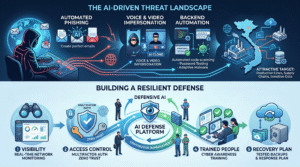
Rather than trying to address every risk at once, we recommend that companies use the coming planning cycle to focus on a few foundations. The first is complete visibility across sites, devices, cloud services, and AI tools, because nothing else works well without it. The second is strong identity protection, including phishing resistant authentication for critical accounts and a disciplined approach to administrator privileges. The third is a modern network design with segmentation, up to date firewalls that can inspect encrypted traffic, and reliable internet connectivity with redundancy for the sites where downtime is costly. The fourth is monitoring and response that can operate around the clock, whether through an internal team or a managed security service, since attacks do not follow office hours. The fifth is tested recovery, including offline backups and an incident response plan that the whole organization has actually practiced.
Employee awareness should continue throughout all of these efforts, with training that reflects realistic scenarios such as deepfake calls and convincing emails in the employee’s own language, rather than generic annual presentations.
The direction of travel is clear. Attacks will be faster, more personalized, and more automated, and the tools that businesses adopt to improve productivity will themselves need protection. The encouraging reality is that the foundations of good defense have not changed, and organizations that invest steadily in visibility, identity, network design, and preparedness are in a much stronger position than those that wait for a specific incident to force the decision.