There is a scenario that plays out in businesses far more often than most leadership teams realize. An employee receives an email that looks like it comes from a courier service, a bank, or even a colleague in another department. The message is professionally written. The logo looks right. The link appears to lead somewhere familiar. They click it without hesitation, and within minutes, something has changed on the network in a way that was never supposed to happen.
That one click is often the beginning of an incident that takes weeks to fully understand and months to recover from. The employee did not act maliciously. They were not careless in any obvious sense. They simply made a judgment call in a few seconds, the way everyone does dozens of times a day, and that judgment happened to be wrong. Understanding why this happens, and what follows from it, is essential for any business that takes its operational continuity seriously.
The Click Is Never the Whole Story
When a breach is traced back to a single user action, it can be tempting to frame the problem as a training issue and move on. If only the employee had been more careful, the thinking goes, none of this would have happened. But that framing misses the more important question: what conditions allowed a single click to cause significant damage across the entire organization?
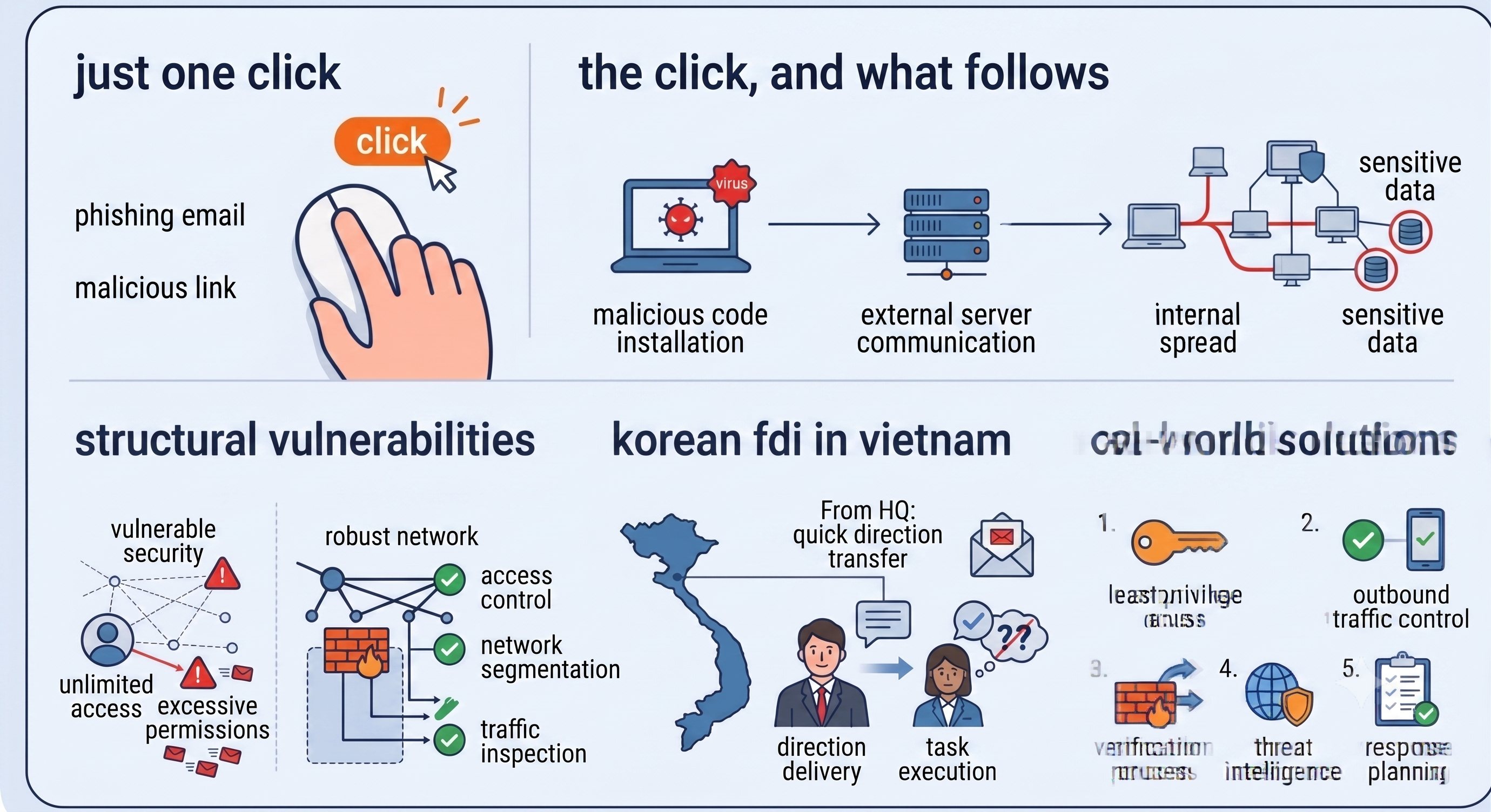
The answer almost always points to something structural. The user had access to more systems than their role required. The network did not distinguish between a trusted internal device and a compromised one. There was no mechanism in place to catch unusual outbound traffic before it left the perimeter. Malicious code, once it landed on one endpoint, found nothing meaningful standing in its way.
The click was the entry point. But it is the architecture of the environment, what was or was not in place around that entry point, that determined how far the damage spread.
What Actually Happens After a Malicious Click
To appreciate the real risk, it helps to understand the sequence of events that typically follows a successful phishing attempt or a drive-by malware download. In the first moments, malicious code establishes a foothold on the affected device. It may begin by gathering information about the local environment: what software is installed, what credentials are cached, what network shares are accessible. This reconnaissance phase is often quiet and generates little activity that would alert an untrained observer. From there, the code typically attempts to communicate with an external server controlled by the attacker. This command-and-control communication is how attackers receive instructions and exfiltrate data. If outbound traffic is not monitored or filtered, this communication can proceed entirely undetected for days or weeks.
Once the attacker has an active channel, they begin moving through the network looking for higher-value targets. A workstation in the finance department might lead to accounting systems. A device used by someone in IT might carry credentials that grant access to servers, backups, or configuration files. In environments without proper segmentation, there is often very little separating the initial point of compromise from the most sensitive systems in the organization.
By the time the breach is detected, which in many cases happens only when something visibly breaks or when a ransomware note appears on screen, the attacker may have been present for weeks. They have likely already copied what they came for, whether that is customer data, financial records, intellectual property, or access credentials that can be sold or used elsewhere.
Why Businesses with Korean Management Teams Face Particular Exposure
For Korean companies operating in Vietnam, the communication dynamics that make the work environment efficient can also create specific vulnerabilities that attackers deliberately exploit.
Instructions and financial approvals often flow quickly from Korean leadership to Vietnamese staff, and the expectation is that those instructions will be acted on without extensive back-and-forth. Attackers who understand this structure can craft messages that impersonate executives, finance directors, or Korean headquarters, and frame requests in a way that makes questioning them feel inappropriate. A payment instruction that appears to come from the CEO, written in the right tone and referencing a plausible business context, will often be acted on before anyone thinks to verify it through a separate channel.
Cross-border operations also tend to involve more remote access points, more cloud services, more third-party platforms, and more variation in the devices and networks that staff connect from. Each of those elements extends the environment that needs to be protected, and each one represents a potential entry point that requires consistent monitoring.
The Role of the Network in Containing the Damage
Training employees to recognize phishing attempts is valuable, and no security program should skip it. But human judgment is not a reliable last line of defense. People are tired, distracted, and operating under time pressure. Attackers are patient, creative, and continuously refining their techniques. Even well-trained employees make mistakes, and the stakes of a single mistake should never be the compromise of the entire business.
What separates a recoverable incident from a catastrophic one is almost always the presence or absence of technical controls that catch threats the user missed. A well-configured network environment should stop suspicious outbound connections before data leaves the perimeter. It should identify unusual lateral movement between internal systems and raise alerts before an attacker reaches their target. It should keep guest devices and internal systems isolated from each other, and ensure that a compromised workstation in one department cannot freely access systems in another. Traffic inspection at the network level can identify malicious patterns even when the user has no idea anything is wrong.
These controls do not eliminate the risk of a click happening. They determine what that click can actually reach. Protecting against threats that enter through user behavior requires more than policy. It requires visibility, and that visibility needs to be built into the network itself. While no single measure removes all risk, there are several approaches that meaningfully reduce the likelihood of a single click becoming a business-wide event.
The first is to ensure that staff have only the access they genuinely need. When an employee’s account is compromised, the damage is bounded by what that account could reach. Excess permissions transform a limited incident into a broad one.
The second is to establish clear verification procedures for financial transactions and requests that fall outside normal workflow patterns. These procedures should be practiced regularly so that following them feels natural rather than bureaucratic, especially when the request appears to come from a senior figure.
The third is to ensure that outbound traffic from the network is inspected rather than allowed to flow freely. Many breaches could be interrupted at the communication phase if the right controls were in place to catch traffic going to destinations that should not be reachable from an internal device.
The fourth is to maintain up-to-date threat intelligence and apply it consistently. Attackers reuse infrastructure, and connections to known malicious destinations can be blocked automatically when that intelligence is applied at the network level.
The fifth is to have a plan for what happens when something does go wrong. Knowing who gets called, what gets isolated, and how operations get restored means the response starts immediately rather than after a period of confusion.
The click is the moment that gets remembered after a breach, but it is rarely the real cause of the damage. Businesses that emerge from security incidents with limited harm are not necessarily the ones whose employees never make mistakes. They are the ones that built their environments with the assumption that mistakes would happen and put controls in place that kept those mistakes from cascading.
If your business is operating in Vietnam and you are not certain what would happen in your network after one of your employees clicked the wrong link today, that uncertainty is worth acting on. The gap between “probably fine” and “definitely protected” is exactly where serious incidents take root.
Beyondnet provides internet, network, and IT infrastructure services to international enterprises operating in Vietnam, with a focus on Korean FDI companies across Hanoi and Ho Chi Minh City.