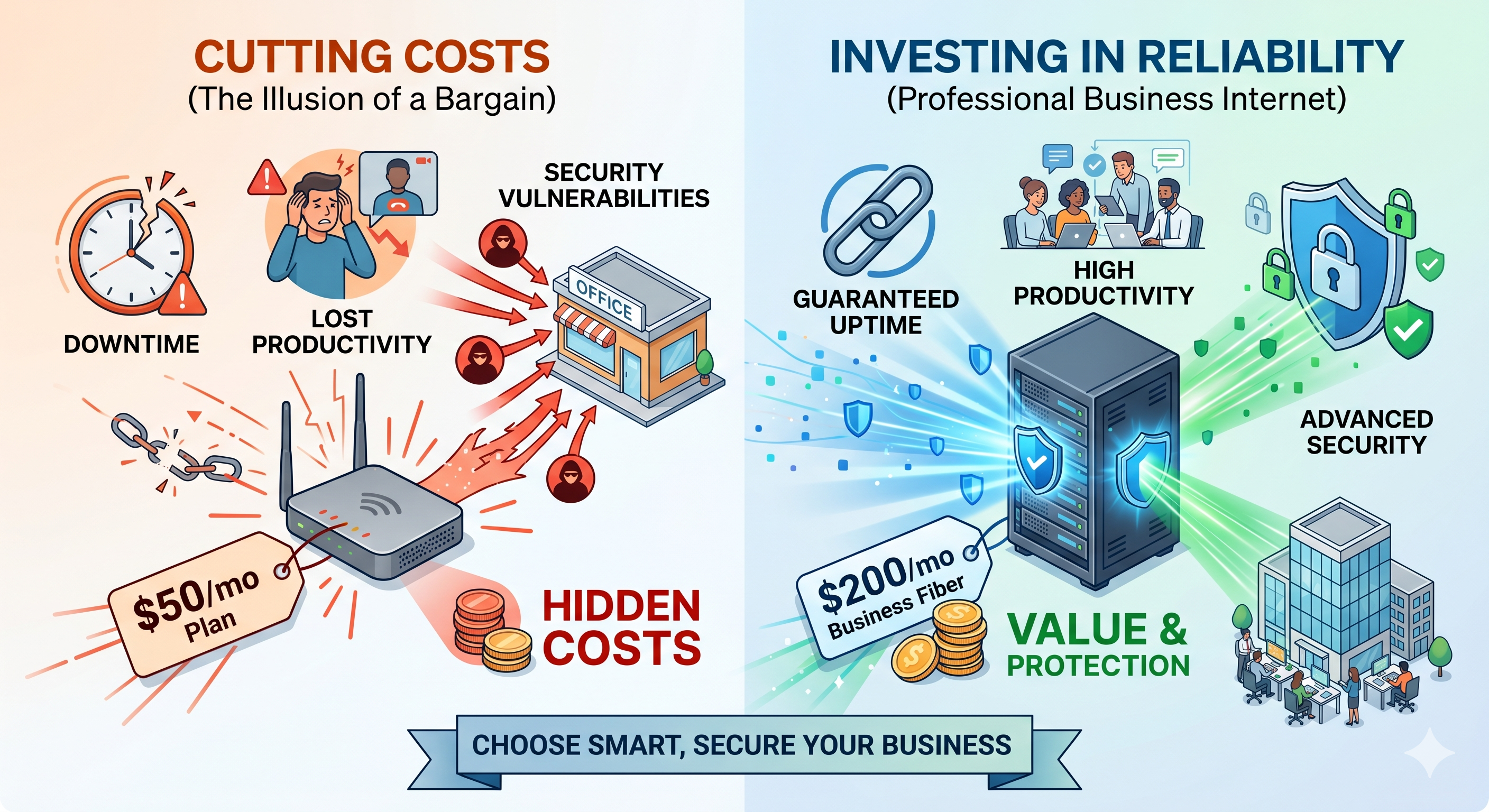
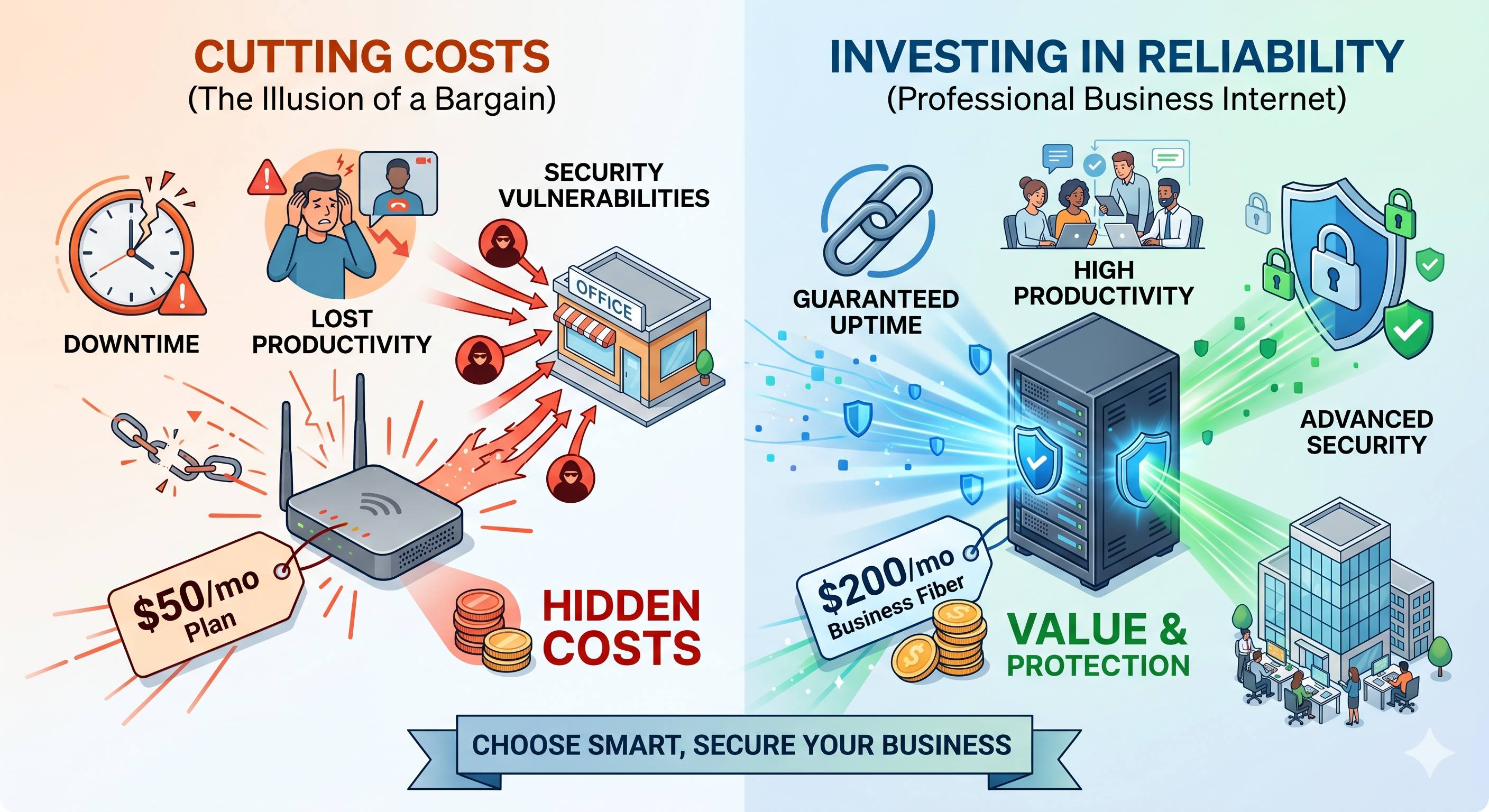
Cutting costs on internet service seems pragmatic, but what looks like a smart budget decision can quietly expose your business to security vulnerabilities, productivity losses, and legal liability.
When an office manager compares a $50/month residential-grade plan to a $200/month business-grade fiber line, the math seems obvious. But this comparison ignores what is not in the price: no uptime guarantees, no priority support, no static IP, no legal right to commercial use, and crucially, no contractual protection when the connection fails at 9 AM on a Monday morning.
Business internet typically costs two to three times more than residential plans with similar speeds, but the gap is justified by guaranteed uptime, symmetrical speeds, priority support, and legal commercial use rights that residential contracts explicitly prohibit.
Security: the invisible attack surface
Network infrastructure devices (routers, modems, switches) are among the most targeted entry points for attackers. Consumer-grade hardware is especially vulnerable: few small office and home office routers run antivirus or integrity tools, manufacturers ship them with exploitable services enabled by default, and owners rarely change default credentials or apply patches.
According to Verizon’s 2025 Data Breach Investigations Report, zero-day exploits targeting edge devices and VPNs grew almost eightfold year-over-year. Cheap, unmanaged routers are primary targets because they are rarely patched and hold enormous lateral access once compromised.
Man-in-the-middle attacks, network snooping, and Evil Twin spoofing are all amplified when the underlying connection lacks enterprise-grade encryption and traffic monitoring. A cheap ISP does not provide these controls – and a compromised network can expose employee credentials, financial data, and client records simultaneously.
Reliability: the productivity tax nobody measures
The hidden cost of downtime is rarely calculated until it happens. Downtime can cost less than $1,000 per minute for small businesses and more than $7,900 per minute for enterprise-sized organizations. A cheaper plan with a weaker SLA can ultimately cost more in lost productivity when issues arise.
Standard consumer SLAs promise 99.9% uptime – which sounds reassuring but permits up to 8.7 hours of downtime per year. Premium business SLAs guarantee 99.99%, reducing that to just 52 minutes annually. The difference matters most when your VoIP phone system, cloud applications, payment processors, and client-facing tools all depend on the same connection.
Beyond full outages, consumer broadband throttles bandwidth during peak hours. Video conferences drop frames. Cloud backups stall. Large file transfers time out. These are invisible productivity taxes that never appear on a line item but compound quietly across an entire team.
Legal and compliance exposure
Using a residential internet line for commercial purposes technically violates most ISP service agreements, which explicitly prohibit commercial use. This gives providers grounds to terminate service without notice if discovered – at exactly the moment your business depends on it most.
For regulated industries handling health records, financial data, or personal customer information, the stakes are higher. A breach traced back to an insecure consumer-grade connection can trigger regulatory investigations and penalties. Cybersecurity Ventures estimates global cybercrime damage costs at $10.5 trillion annually by 2025 – regulators are taking network security obligations seriously.
What to look for instead
- Require a formal SLA guaranteeing at least 99.9% uptime, with defined response times (4 hours or less for business-critical issues) and service credits for failures.
- Insist on a static IP address – essential for VPN access, email server reputation, remote management, and ecommerce platforms.
- Choose dedicated internet access (DIA) over shared broadband wherever budget allows – dedicated lines are not shared with other businesses or households, reducing breach risk.
- Read SLA exclusions carefully. Some providers deny liability for cybersecurity incidents including ransomware – know what is and is not covered before signing.
- Implement a failover connection using a different technology (e.g., fiber primary with cellular LTE backup). The cost of a backup line is almost always less than the cost of a single major outage.
- Replace consumer-grade routers with business-grade hardware that receives regular firmware updates, supports VLANs, and has enterprise firewall capabilities.
At Beyondnet, we believe business internet should deliver more than bandwidth. It should provide a secure, stable, and professionally managed foundation for daily operations.
Ready to upgrade your connectivity?
By combining enterprise-grade connectivity with integrated network security services, proactive monitoring, and local technical support, Beyondnet provides a secure, stable, and professionally managed foundation for daily operations.