Vietnam’s industrial boom is attracting world-class manufacturers – but the companies that operate with confidence are the ones that treat connectivity as critical infrastructure, not a commodity.
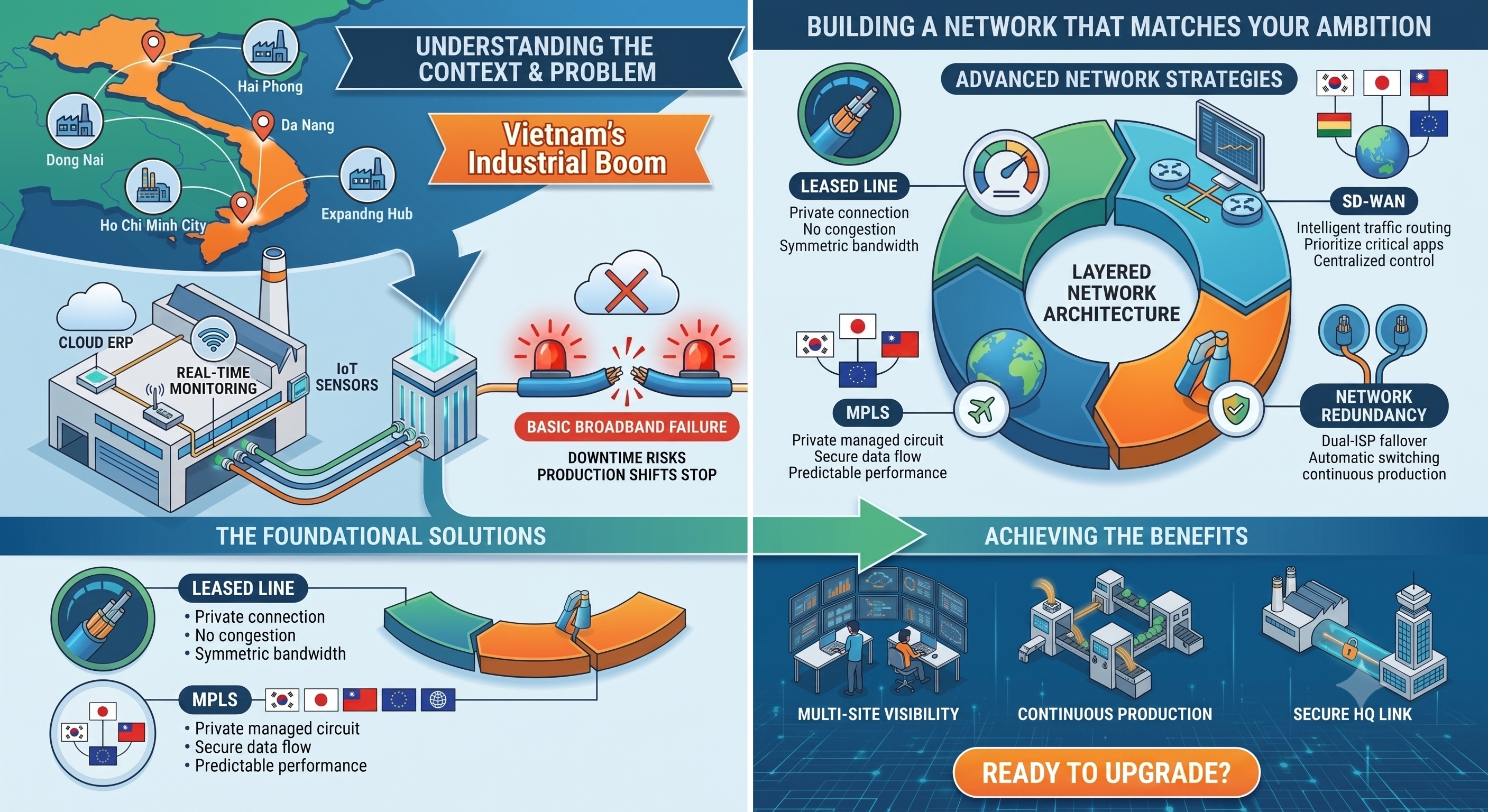
Vietnam has solidified its position as one of Southeast Asia’s most important manufacturing destinations. Foreign direct investment continues to flow into major industrial hubs – including Ho Chi Minh City, Dong Nai, Hai Phong, and Da Nang – as global companies diversify supply chains and build long-term production capacity in the country. Following provincial mergers that took effect in mid-2025, these hubs now form larger, more integrated industrial zones with expanded labor markets and improved regional logistics.
In this environment, the pressure on IT and operations teams has never been greater. Factory floors are becoming more connected, not less. Cloud-hosted ERP systems, real-time machine monitoring, remote quality audits with overseas headquarters, and the growing density of IoT sensors on production lines – all of it runs on your network. And when that network fails, operations stop.
“Connectivity is no longer a utility sitting beneath your operations. It is the operational backbone.
When it fails, everything else follows.”
This is why the conversation around premium internet service for industrial environments has matured so quickly. Standard broadband was not designed for the uptime expectations of a modern factory. What manufacturing enterprises need is a deliberate, layered network architecture – and a partner who understands the technical demands and the on-the-ground realities of operating in Vietnam.
The problem with “good enough” connectivity
Many facilities start their Vietnam operations with a basic broadband connection. It is cheap, fast to install, and adequate in the early stages. But as operations scale – more machines, more cloud applications, more sites, more people – the vulnerabilities of a basic setup become impossible to ignore.
A single ISP connection with no redundancy means that one fiber cut, one provider outage, or one upstream routing failure becomes your entire problem. There is no fallback. For facilities running continuous production shifts, that is not a minor inconvenience – it is a direct hit to output, SLA compliance, and the trust of customers and headquarters alike.
The issue is not just downtime. It is the compounding risk of building critical, interconnected operations on a foundation that was designed for ordinary office browsing. The more your factory relies on cloud systems and real-time data, the more your connectivity infrastructure needs to match that reliance.
Building a network that matches your ambition
A robust industrial connectivity strategy is not a single product – it is a stack. The right architecture for a Vietnam-based factory typically combines several complementary technologies, each addressing a different layer of the problem.
- Leased Line: A dedicated leased line gives your facility a private, uncontended connection directly to the internet backbone. Unlike shared broadband, the bandwidth is yours alone – consistent, symmetric, and unaffected by peak-hour congestion from neighboring businesses or residential traffic. For data-intensive workloads such as CAD file transfers, continuous machine telemetry, cloud backup, or high-definition video calls with headquarters, this is the foundation everything else builds on.
- SD-WAN: Software-Defined Wide Area Networking brings intelligence to how your traffic is routed across multiple connections. Rather than forcing all data through a single pipe, SD-WAN dynamically distributes workloads based on real-time network conditions and business policy – prioritizing your ERP or voice traffic, keeping latency-sensitive applications smooth, and routing less critical data over lower-cost links. It also dramatically simplifies management: network policies are set centrally and applied across all sites, rather than configured manually at each location. For multi-site industrial groups with factories, warehouses, and offices spread across Vietnam or the broader region, SD-WAN is what makes the entire network feel coherent and responsive. It is now a standard component of modern enterprise WAN architecture, often deployed alongside or in place of legacy solutions.
- MPLS: Multiprotocol Label Switching provides a private, managed circuit between your sites – factory to headquarters, Vietnam plant to parent company in Korea, Japan, Taiwan, or Europe. Because MPLS traffic travels on a dedicated path isolated from the public internet, it offers predictable performance and a much smaller security exposure. It is particularly well-suited for enterprises with specific compliance requirements, sensitive inter-site data flows, or workloads where consistent, guaranteed performance cannot be left to the variability of the public internet. Many organizations today operate in a hybrid model, using MPLS where strict isolation matters and SD-WAN for flexibility and cost efficiency everywhere else.
- Network Redundancy: No single link should be a single point of failure. Enterprise-grade deployments use dual-ISP configurations with automatic failover – and sometimes a 4G or 5G backup path – to ensure that even during a fiber outage, operations continue without manual intervention. For any facility running around-the-clock shifts, redundancy is not a premium option. It is the line between a minor incident and a production crisis.
- Multi-site visibility: SD-WAN gives your IT team centralized control and visibility across every factory, office, and warehouse – without visiting each site.
- Continuous production: Dual-ISP failover keeps lines running automatically when a primary connection drops – no manual switching, no production gap.
- Secure HQ link: MPLS private circuits protect sensitive R&D, financial, and operational data from exposure on the public internet.
Planning your infrastructure roadmap
The most strategically-minded factory operators are not just solving today’s connectivity problem – they are designing for what the next two to five years will demand. Industry 4.0 applications – IoT sensor networks, AI-powered quality inspection, autonomous guided vehicles, real-time supply chain integration – all require a network that is fast, low-latency, and always available. Getting there does not happen in a single step
An infrastructure roadmap is the planning process that connects where your operations are today with where they need to be. It means auditing your current setup honestly: where is bandwidth being constrained? Which applications are suffering? What happens when a link goes down? It means forecasting growth – more devices, more sites, higher data volumes – and sequencing investments in the order that delivers the most operational impact.
Critically, it also means choosing the right connectivity partner – not just a vendor who sells bandwidth, but one who can help you think through the architecture, understand the trade-offs between technologies, and support you through implementation, change, and growth. In Vietnam’s industrial market, local knowledge matters enormously. Which fiber routes serve which industrial zones reliably, where last-mile infrastructure is strong or weak, how to connect a Vietnam facility cleanly to a regional or global WAN – these are not generic questions with generic answers.
Why Beyondnet
Beyondnet was built specifically for enterprises operating in Vietnam’s industrial and manufacturing landscape. We understand the local infrastructure – the fiber coverage across major industrial hubs in Ho Chi Minh City, Dong Nai, Hai Phong, and Da Nang – and we have the international backbone relationships to connect your Vietnam operations seamlessly into your broader regional or global network.
Our solutions span dedicated leased lines, SD-WAN deployments, MPLS private networks, and fully redundant multi-ISP configurations – designed, installed, and supported by a team that understands both the technology and the demands of industrial operations. We do not apply a generic template. We design around your specific sites, your applications, your traffic patterns, and your growth plans.
Whether you are setting up a greenfield factory and want to build the network correctly from day one or managing an existing facility that has outgrown its current connectivity, Beyondnet is ready to build a solution that performs as hard and as consistently as your team does.