In the period when IPv4 was still dominant, many enterprises approached IT services mainly as a way to “fix problems when they occurred.” When the network slowed down, systems failed, or devices malfunctioned, they contacted technical vendors for quick remediation, with cost and response time being the primary selection criteria. This model was relatively effective in simple infrastructures with limited scale and low cloud dependency.
However, as IPv6 is increasingly deployed across cloud platforms, CCTV systems, IoT devices, multi-branch connectivity, and cross-border digital services, enterprise IT infrastructures are no longer merely complex in size, but also in depth. Risks no longer originate from a single failure point, but from the lack of synchronization between the network, security, and operations layers. Under these conditions, enterprises are required to fundamentally change the way they evaluate and select IT service providers.
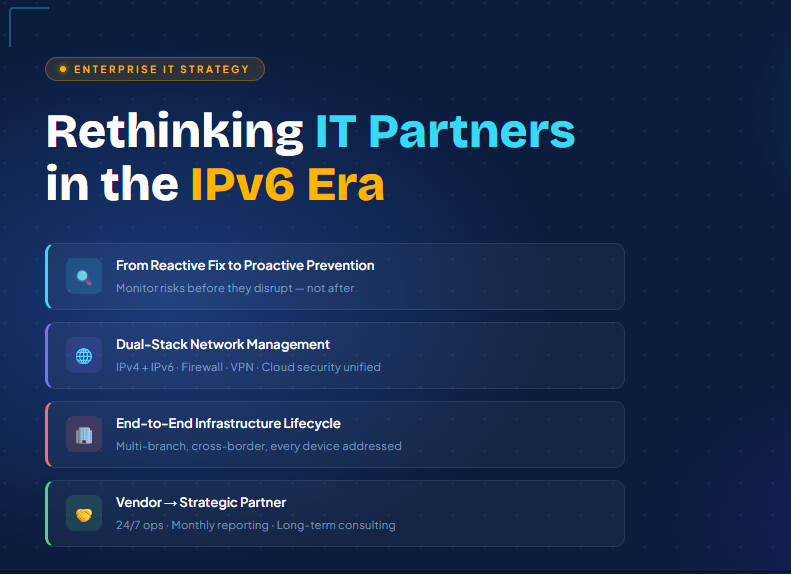
Instead of asking only, “How fast can you fix an issue?”, enterprises now need to consider more systemic capabilities: whether the provider can monitor both IPv4 and IPv6 environments, manage firewalls, VPNs, and cloud security across dual-stack networks, and-more importantly-whether they possess proactive monitoring mechanisms that detect risks before they disrupt operations. The demand has shifted from simple troubleshooting to comprehensive risk prevention.
At the same time, business expansion across multiple branches, regions, or international headquarters requires IT partners with end-to-end operational capabilities rather than fragmented service scopes. With IPv6 enabling every device to have its own address, access control becomes more granular-but also far more challenging to manage. Enterprises therefore require not only an initial deployment vendor, but a long-term partner capable of managing the entire infrastructure lifecycle.
Another critical shift lies in how enterprises define the relationship with their IT service providers. In the IPv6 era, where boundaries between internal networks, cloud environments, the Internet, and partner systems are increasingly blurred, IT operations can no longer be separated from business strategy. IT vendors are no longer viewed merely as “service providers,” but as “infrastructure operation partners.” Leading enterprises are now prioritizing providers with clear operational processes, 24/7 monitoring systems, structured monthly reporting, and the ability to offer mid- to long-term infrastructure consulting-rather than those who only intervene after problems occur.
Network, security, and Internet service providers must also re-engineer core network structures, upgrade edge equipment, establish IPv4 and IPv6 integrated security policies, and ensure compatibility with the global cloud environment at the same time. Companies that fall behind in this transition are likely to experience significant challenges in securing new customers as well as retaining existing ones.
In the end, the competitiveness of IT outsourcing companies in the IPv6 era will not be determined by who builds faster, but by who operates more reliably, who controls risk more effectively, and who can grow together with customers in a longer-term perspective.