The shift to cloud-based operations is no longer a trend – it’s the new standard for businesses of all sizes. And with that shift comes a critical question many business owners overlook until it’s too late: is your internet connection actually built to handle it?
Cloud environments demand consistent, high-performance connectivity. Depending on how your systems are configured, your bandwidth needs may be significantly higher than you’d expect – and a slow or unstable connection can quietly become one of your biggest operational bottlenecks.
The good news? Connectivity costs have never been lower.
The rollout of NBN and expanded fibre infrastructure has driven internet pricing down considerably. In fact, it’s now entirely possible for a home user down the street to be running faster speeds than your office – with residential NBN plans regularly hitting 100Mbps down and 40Mbps up, and fixed wireless services offering up to 50Mbps download.
But here’s what that comparison misses entirely.
Business internet isn’t just faster home internet.
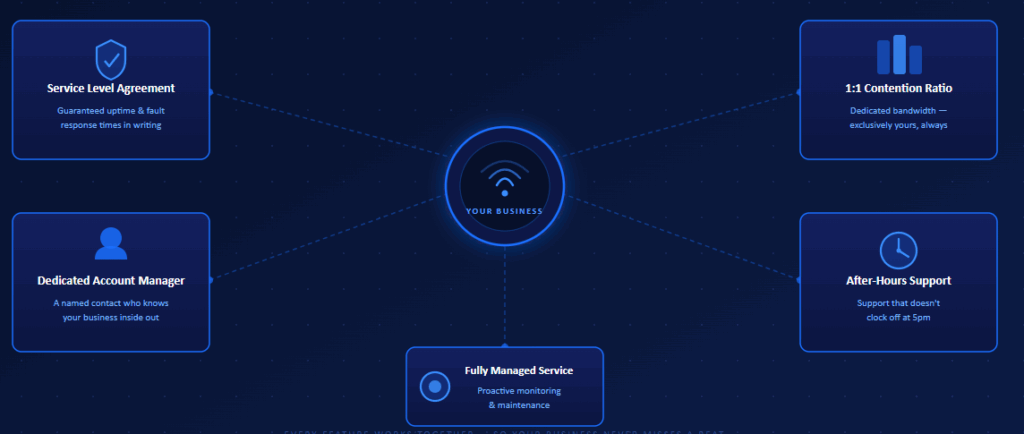
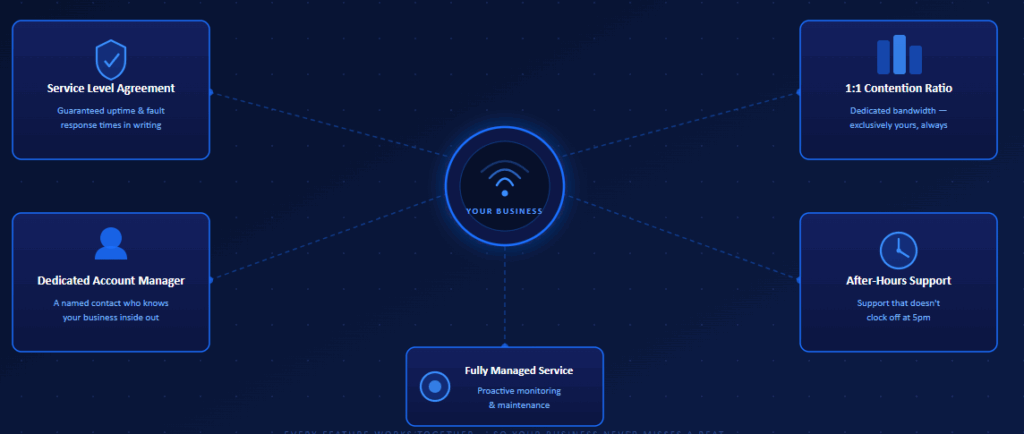
What Your Business Internet Should Actually Deliver. Read more:
The real differentiators aren’t always visible in a speed test. A quality business ISP brings service level agreements (SLAs) that hold them accountable to uptime, dedicated account management, and critically – a 1:1 contention ratio. That last point matters more than most people realize.
Contention ratio refers to how many customers share the same bandwidth on a network. A 40:1 ratio means up to 40 businesses are competing for the same pipe at any given moment. A 1:1 ratio means your bandwidth is yours – full stop. Premium business ISPs take this further with fully managed services and after-hours support, so you’re never left troubleshooting an outage at 9pm on your own.
So what does your cloud setup actually need?
As a baseline, any business relying on cloud systems for day-to-day operations – whether that’s a site-to-site VPN connecting multiple offices or a shared file platform like Dropbox Business – should be working with a minimum 10Mbps symmetrical connection. That’s the floor, not the target.
Your actual requirements will depend on headcount, how your systems are architected, and whether external teams or clients are regularly accessing your network remotely. These variables add up quickly.
Your internet connection is infrastructure – not a utility bill to minimize. With business operations now dependent on always-on cloud access, choosing the right ISP means evaluating more than price. It means understanding your bandwidth needs, demanding proper SLAs, and working with a provider who treats your uptime as their responsibility. Not sure where your current setup stands? It’s worth getting an honest assessment before your connectivity becomes the reason a system fails.