Modern Productivity Runs on Networks
The way businesses operate has fundamentally shifted. Traditional communication tools like email and basic chat no longer define how teams get work done. In today’s environment, real productivity comes from people collaborating simultaneously – co-editing documents in the cloud, joining video calls across continents, and monitoring live dashboards in real time.
In this context, Wi-Fi is no longer just background infrastructure. A corporate wireless network has become a core business asset – one that directly influences operational efficiency. For any organization looking to stay competitive, deploying a reliable, enterprise-grade Wi-Fi network isn’t optional; it’s a strategic necessity. A robust connection minimizes downtime, strengthens team collaboration, and delivers seamless digital experiences to both staff and customers.
The Direct Link Between Wi-Fi and Workforce Efficiency
Today’s work environments demand far more from their networks than simple web browsing or file transfers. Stable, fast, and secure business internet Wi-Fi is now the backbone of modern workflows:
• Hybrid Work: Employees move fluidly between office and remote settings, expecting consistent access to video conferencing tools, VPNs, and shared cloud drives at all times.
• Cloud-First Operations: Business-critical platforms – including CRMs and ERPs – are hosted entirely in the cloud. Any connectivity gap translates directly into lost productivity.
• Collaboration Tools: Platforms such as Microsoft Teams, Zoom, and Slack depend on low-latency connections to function properly during live communication.
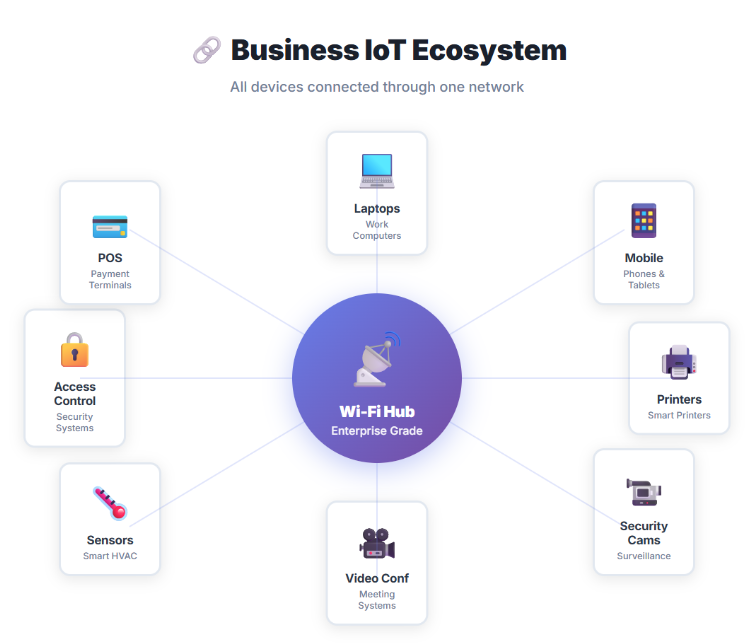
• IoT Integration: Modern offices increasingly rely on smart devices – from connected printers and environmental sensors to access control systems – all of which run on Wi-Fi.
What Makes a High-Performance Business Wi-Fi Network
When choosing a Wi-Fi solution for business, organizations should prioritize the following capabilities:
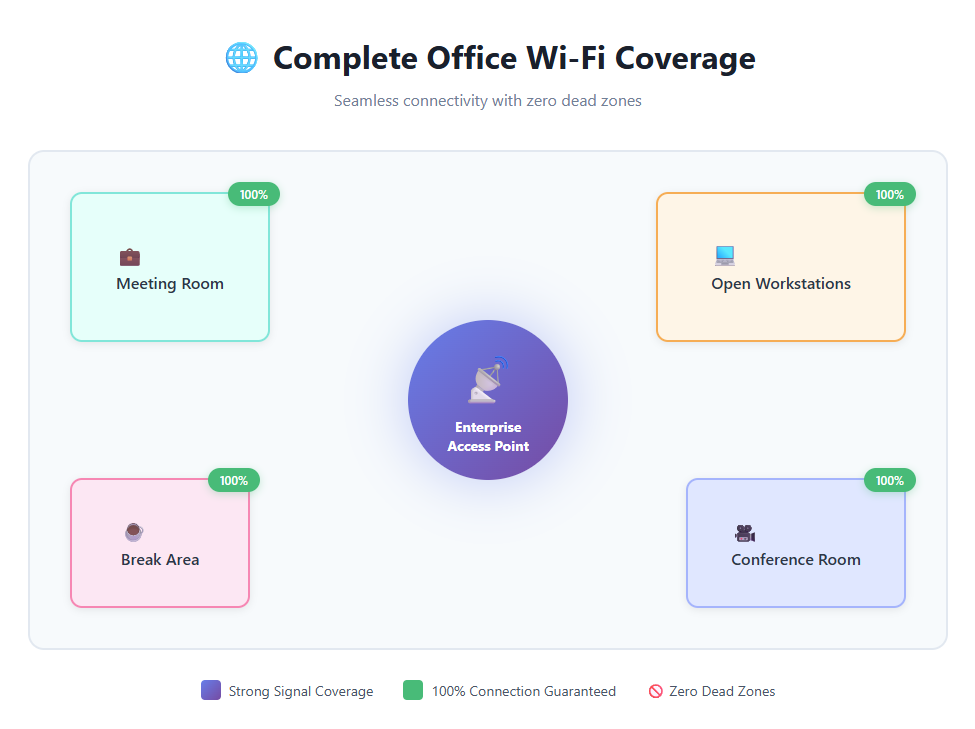
- Blanket Coverage with No Dead Zones: Employees shouldn’t lose connectivity when moving between conference rooms, open workspaces, or informal collaboration areas. A well-designed enterprise Wi-Fi network uses strategically placed access points to ensure consistent signal strength throughout the entire facility.
- Scalable Architecture: As headcount grows and more devices connect to the network, performance shouldn’t degrade. A scalable Wi-Fi for business solution accommodates growth without requiring a full infrastructure overhaul.
- Intelligent Bandwidth Prioritization: Not all traffic carries equal business value. Enterprise-grade Wi-Fi applies Quality of Service (QoS) policies that allocate bandwidth to high-priority applications like video conferencing and cloud services, while deprioritizing non-work-related traffic.
- Built-In Security Without Friction: Security breaches can halt operations entirely. Enterprise Wi-Fi solutions incorporate WPA3 encryption, firewall protection, and guest network segmentation – keeping the network secure without creating unnecessary friction for legitimate users.
- Network Analytics and Visibility: Advanced Wi-Fi platforms provide real-time insights into usage patterns and performance metrics. IT teams can identify bottlenecks, monitor traffic behavior, and make data-driven decisions to continuously optimize the network.
Impact Beyond the Workplace
A strong wireless infrastructure benefits more than just internal operations. In retail, Wi-Fi supports point-of-sale (POS) systems, digital signage, and mobile customer applications. Hotels and hospitality venues rely on it to deliver the kind of seamless internet experience guests now expect as standard. In healthcare, Wi-Fi connects electronic health records, telemedicine platforms, and networked medical devices in real time – where reliability can be a matter of patient safety.
Whether serving employees or end customers, the quality of connectivity shapes every digital interaction.
Key Trends Accelerating the Demand for Better Business Wi-Fi
Several forces are pushing organizations to upgrade their wireless infrastructure:
• Hybrid and Flexible Work: In-office networks must handle intensive collaboration workloads while integrating smoothly with remote access solutions.
• 5G Integration: Many businesses are now combining 5G with Wi-Fi to build redundant, high-speed connectivity layers for mission-critical applications.
• Wi-Fi 6 Adoption: The latest wireless standard offers higher throughput, reduced latency, and significantly better performance in dense device environments – making it well-suited for modern office deployments.
• IoT Expansion: As smart HVAC systems, IP cameras, and other connected devices proliferate, networks must be both scalable and secure enough to manage them without introducing new vulnerabilities.
• Cloud Dependency: With virtually every business application migrating to the cloud, always-on connectivity is no longer a luxury – it’s a fundamental operational requirement.