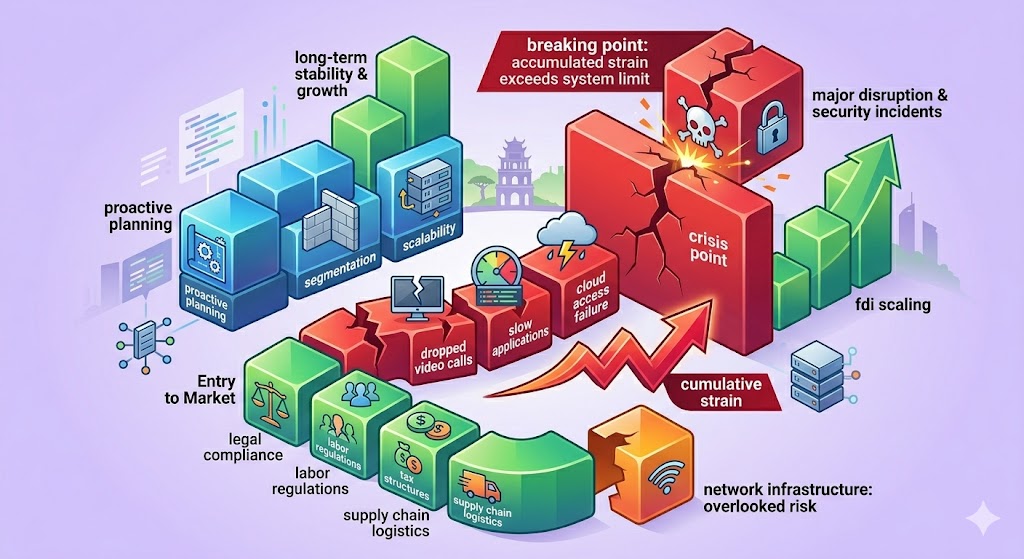
Foreign invested companies often spend significant time and resources evaluating risks before entering a new market. Legal compliance, labor regulations, tax structures, and supply chain logistics all receive careful attention during the planning phase. Network infrastructure, however, is frequently treated as a secondary concern, something that can be addressed once operations are already underway.
This is one of the most common blind spots among FDI companies setting up in Vietnam, and it often turns into a far more serious problem than anyone anticipated.
Unlike many other operational risks, poor network infrastructure does not announce itself clearly. There is no single dramatic event that signals something is wrong. Instead, the risk builds quietly in the background, showing up as small inconveniences at first before eventually affecting core business functions. By the time leadership recognizes the scale of the problem, the company may already be dealing with significant disruption, lost productivity, or even security incidents that could have been avoided.
The Nature of Hidden Risk
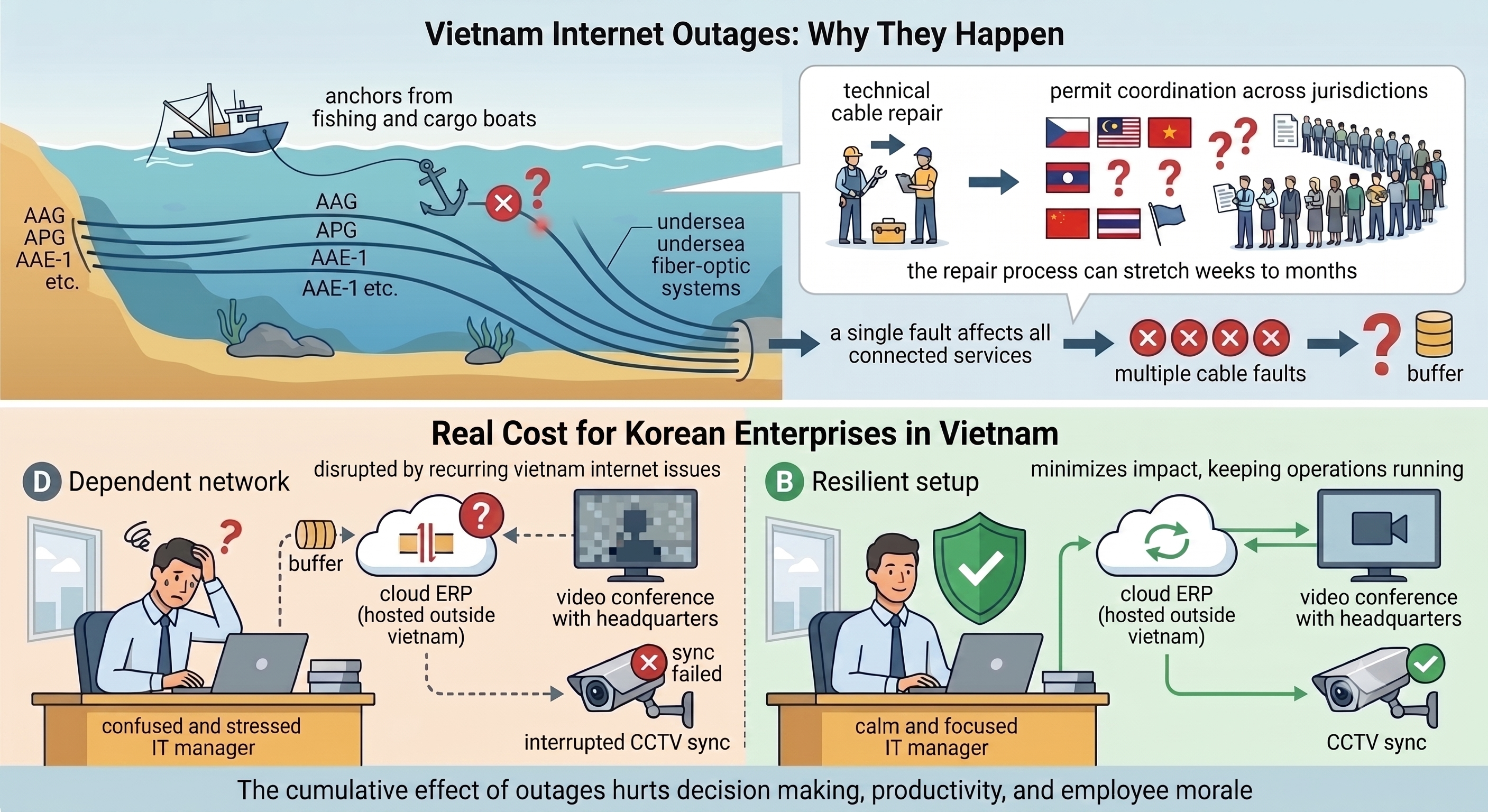
What makes network infrastructure such a hidden risk is that its effects are often misattributed to other causes. A slow application might be blamed on the software vendor rather than the underlying network. A dropped video call with headquarters might be seen as a normal inconvenience rather than a sign of deeper connectivity issues. An employee struggling to access cloud-based systems might simply be told to restart their computer rather than having the network itself examined.
Because these symptoms appear scattered and inconsistent, it becomes difficult for management to connect them to a single root cause. The problem is treated as a series of isolated annoyances rather than what it actually is, a structural weakness in the company’s IT foundation. This is precisely why network infrastructure risk tends to remain hidden for so long. It does not look like a crisis until it actually becomes one.
Why FDI Companies Are Particularly Vulnerable
Foreign invested enterprises operating in Vietnam face a unique combination of factors that make network infrastructure risk more pronounced than it might be for purely domestic businesses.
Many FDI companies, especially Korean enterprises, operate with close coordination between their Vietnam operations and headquarters overseas. This means daily reliance on stable internet connectivity for video conferencing, file sharing, and real time reporting. When the network is unreliable, this coordination suffers directly. Meetings get delayed, reports arrive late, and communication that should be straightforward becomes frustrating for both sides.
There is also the matter of how quickly many FDI companies scale once they establish a presence in Vietnam. A business that starts with a modest office setup may expand rapidly as production increases or as the company wins new contracts. Infrastructure that was adequate for the initial phase often cannot keep up with this growth, yet the urgency of daily operations means there is rarely a natural pause to reassess and rebuild the network properly.
Additionally, many FDI companies bring with them data security expectations shaped by regulations and corporate policies from their home country. A Korean company operating in Vietnam, for example, may need to meet specific data handling standards required by headquarters even while operating within Vietnam’s own regulatory environment. Weak network infrastructure makes it harder to maintain the kind of security segmentation and monitoring that these expectations require, creating a gap between what the company assumes is being protected and what is actually happening at the technical level.
How the Risk Manifests in Daily Operations
The operational consequences of poor network infrastructure tend to appear gradually rather than all at once, which is part of what makes the risk so easy to underestimate.
In manufacturing environments, unreliable connectivity can disrupt systems that monitor production lines or manage inventory in real time. Even brief interruptions can cause data gaps that complicate quality control or create discrepancies in stock records. For companies that rely on just in time production models, these interruptions can ripple through the entire supply chain.
In office environments, slow or unstable networks affect everything from email reliability to the performance of cloud based enterprise systems. Employees may find themselves working around the network rather than relying on it, saving files locally instead of using shared drives, or avoiding video calls because the connection cannot support them reliably. These workarounds might seem minor individually, but collectively they reduce the overall efficiency of the organization and increase the risk of data being mishandled or lost.
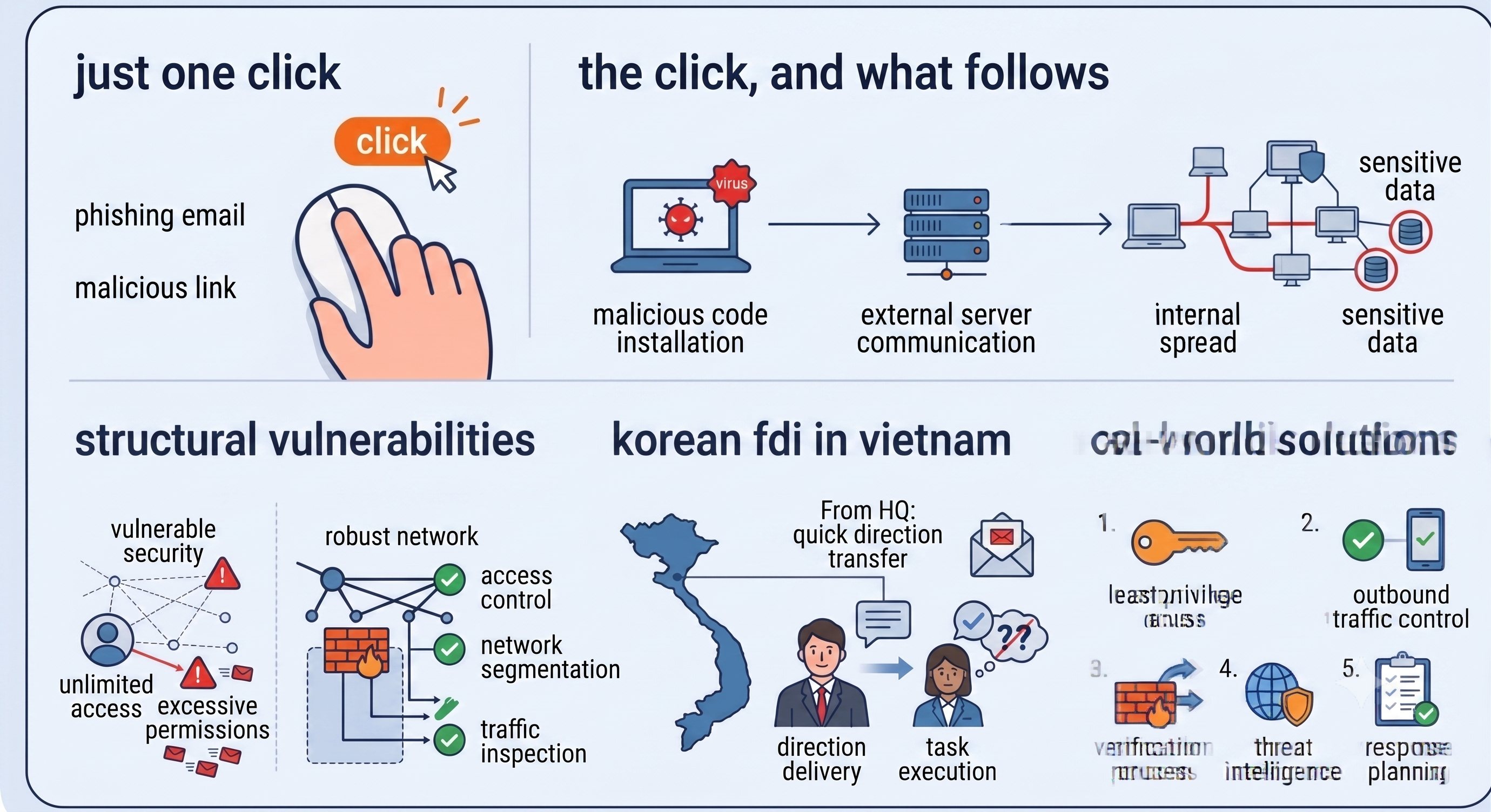
Security is another area where the risk becomes particularly serious. A poorly designed network often lacks proper segmentation between different parts of the business, meaning a security issue in one area can spread more easily to others. Without strong monitoring in place, suspicious activity can go unnoticed for extended periods. For a company handling sensitive client information, proprietary processes, or financial data, this kind of exposure represents a serious liability, one that often remains invisible until an actual incident forces it into the open.
The Compounding Effect Over Time
One of the more dangerous aspects of network infrastructure risk is how it compounds over time. A small inefficiency today might cost an employee a few minutes of lost productivity. Multiplied across an entire workforce and repeated daily, this becomes a substantial drain on overall output. As the company grows and adds more employees, more devices, and more systems, these inefficiencies do not simply stay the same. They tend to multiply, because the underlying infrastructure is being asked to support a load it was never designed to handle.
This compounding effect often explains why companies suddenly find themselves facing what feels like an urgent crisis after years of operating without major issues. In reality, the infrastructure has been struggling for a long time. The visible breaking point is simply the moment when the accumulated strain finally exceeds what the system can absorb.
Addressing the Risk Before It Becomes a Crisis
The good news is that this hidden risk is entirely manageable when it is recognized early and addressed proactively. The first step is simply acknowledging that network infrastructure deserves the same level of strategic attention as other operational risks. This means involving IT considerations in business planning discussions rather than treating them as a separate technical matter handled only when problems arise.
A thorough assessment of the existing network, conducted by professionals who understand both technical infrastructure and the specific operational context of foreign invested enterprises, can reveal vulnerabilities long before they cause visible disruption. This kind of assessment looks beyond simple connectivity speed and examines factors such as redundancy, security segmentation, scalability, and how well the network actually matches the way the business operates day to day.
For companies that have grown organically without a clear infrastructure strategy, this process often reveals gaps that were previously invisible. Identifying these gaps early gives the company the opportunity to address them in a planned and controlled manner, rather than scrambling to fix problems after they have already disrupted operations.
Why This Matters for Long Term Stability
For FDI companies, particularly Korean enterprises building a long-term presence in Vietnam, network infrastructure is not simply a technical detail. It is directly tied to operational stability, security, and the ability to coordinate effectively with stakeholders both locally and overseas. A hidden risk left unaddressed does not stay hidden forever. It eventually surfaces, usually at the most inconvenient time, and often with a cost far greater than what proper planning would have required.
At Beyondnet, this is a risk that is taken seriously in every engagement with clients. As an FDI Korean IT company with extensive experience supporting international and Korean enterprises in Vietnam, the approach involves identifying these hidden vulnerabilities before they become operational emergencies. Recognizing network infrastructure as a strategic priority, rather than a background utility, is one of the most important steps a foreign invested company can take to protect its long-term stability and growth in this market.